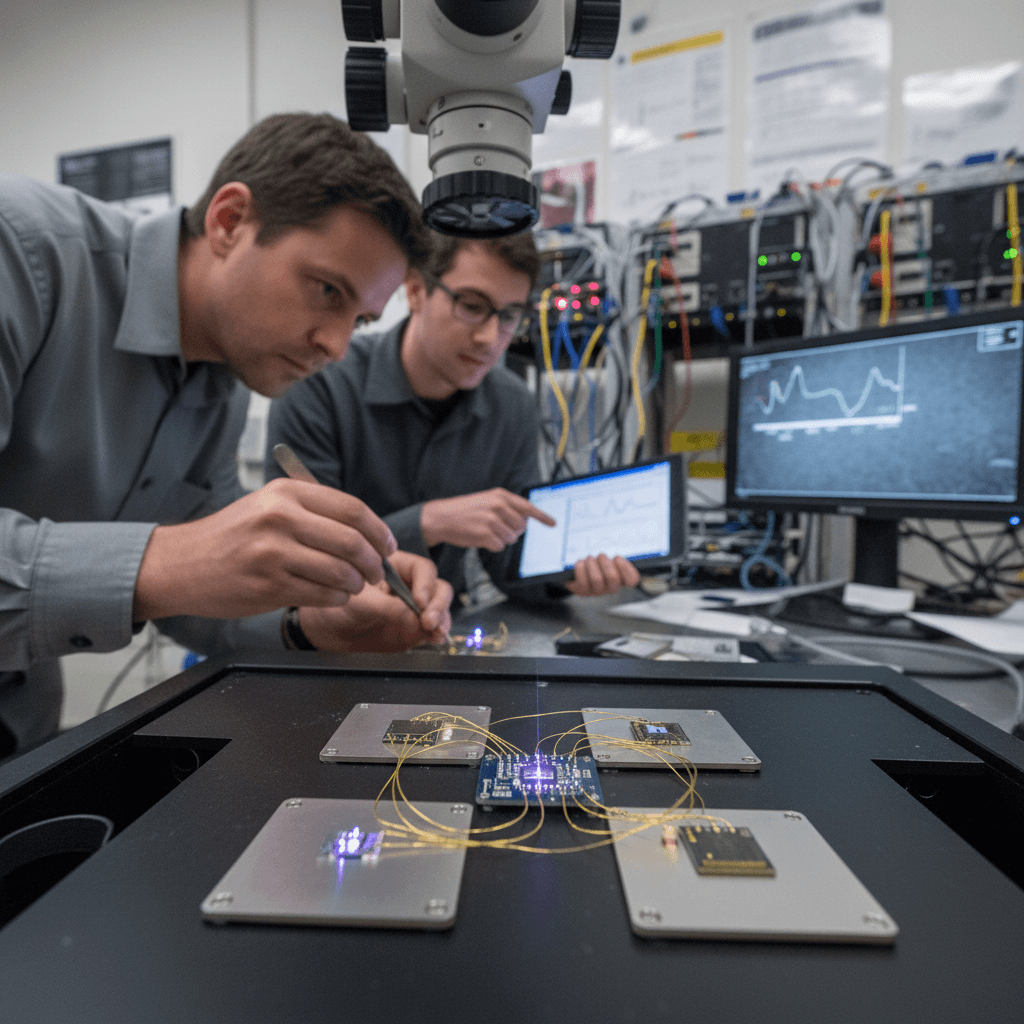
Quantum experiments that once demanded extensive table-top equipment are now being miniaturized, thanks to the development of a new integrated photonics platform. Researchers at the University of California Santa Barbara (UCSB) and the University of Massachusetts Amherst, led by Daniel Blumenthal and Robert Niffenegger respectively, have created a chip-scale device capable of precision quantum experiments.
The innovative device can prepare and control the quantum state of strontium ions at room temperature and drive the clock transition. This advancement is considered a crucial step toward developing portable optical clocks and quantum computers housing millions of qubits.
Traditional quantum computers and optical clocks rely on bulky equipment, with optical reference cavities taking up a significant portion of the device’s volume. The new chip-based system replaces these large, stabilized laser systems with small photonic chips. The system features an integrated Brillouin laser with a 674 nm wavelength connected to an integrated 3-meter-long coil resonator cavity.
The team demonstrated the system’s stability by measuring the 0.4 Hz quadrupole optical clock transition in strontium-88 ions trapped on a single surface electrode trap (SET) chip at room temperature. The 674-nm Brillouin laser eliminates the need for bulky frequency conversion equipment and reduces high-frequency noise, which is crucial for qubit state preparation fidelity. The coil further stabilizes the laser’s carrier frequency, reducing mid- and low-frequency noise.
This combination achieved a frequency noise profile and Allen deviation of 8.8 × 10⁻¹³ for a room-temperature chip, enabling high-fidelity qubit state preparation and clock transition interrogation essential for quantum computing. The miniaturization enhances the portability and robustness of optical clocks, with potential applications in space navigation, gravity mapping, gravitational wave detection, dark matter/energy research, and general relativity measurements.
The researchers are now focused on scaling the platform to a grid of 100 or more ions and integrating all experimental components onto a single, full-architecture chip, with the ultimate goal of reaching a stability range of 10-14 to 10-16.
Leave a Reply