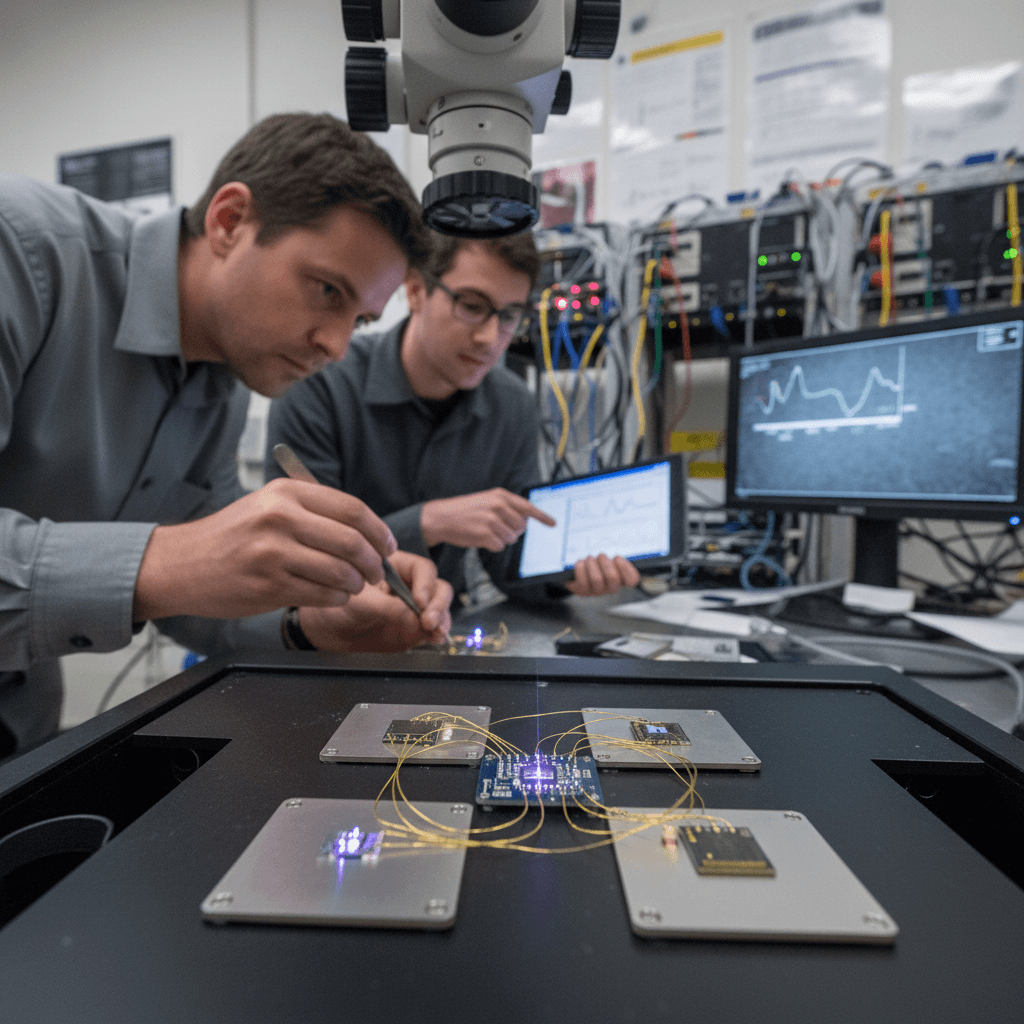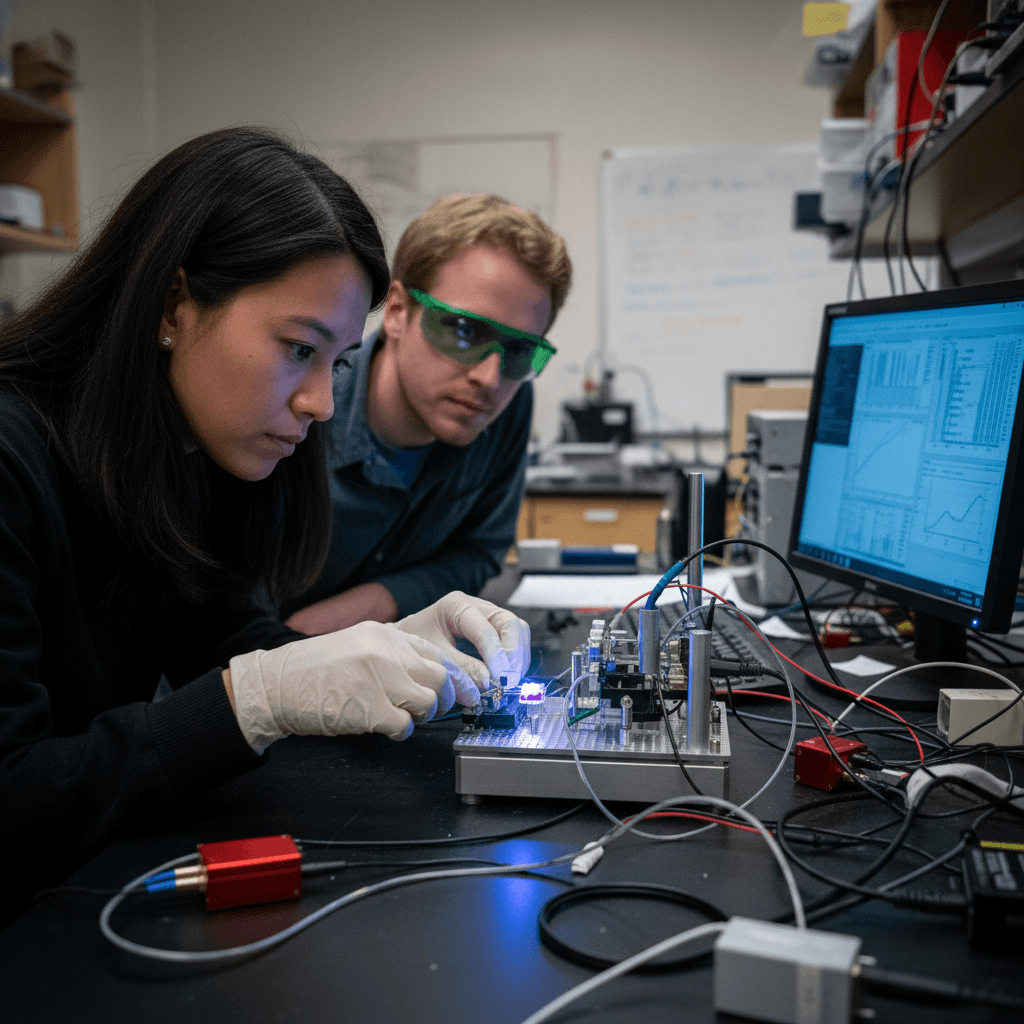
Researchers have developed a new integrated photonics platform that miniaturizes the technology required for precision quantum experiments, which previously necessitated multiple table-top lasers and other bulky equipment. This innovative chip-scale device, created by teams from the University of California Santa Barbara (UCSB) and the University of Massachusetts Amherst, is expected to find applications in quantum computing and portable optical clocks that utilize trapped ions.
Traditional quantum computers and optical clocks rely on extensive setups, including lasers, cryogenic coolers, vacuum chambers, and optical reference cavities. The latter can account for over half of a device’s total volume and are critical for stabilizing laser frequencies to the high precision needed for controlling the quantum states of trapped ions.
The team, led by Daniel Blumenthal of UCSB and Robert Niffenegger at UMass Amherst, has successfully replaced these large, stabilized laser systems with small photonic chips. They demonstrated the chips’ ability to prepare and control the quantum state of strontium ions at room temperature and to drive the clock transition. While the system’s fidelity is not yet on par with the best traditionally constructed devices, Niffenegger considers it a crucial initial step towards developing next-generation clocks and future quantum computers capable of millions of qubits.
The chip-based stabilized laser system comprises an integrated Brillouin laser with a 674 nm wavelength, connected to an integrated 674 nm, 3 m long coil resonator cavity. The stability of this laser and coil was assessed by measuring the 0.4 Hz quadrupole optical clock transition in strontium-88 ions, which were trapped at an electrode on a single surface electrode trap (SET) chip. This achievement at room temperature is particularly noteworthy given the precision of the transition.
Beyond its smaller size, the chip’s 674-nm Brillouin laser eliminates the need for bulky frequency conversion equipment and offers reduced high-frequency noise, which is vital for clock acquisition and qubit state preparation fidelity. The coil further stabilizes the laser’s carrier frequency by reducing mid- and low-frequency noise, allowing it to be locked to the precise sub-Hz trapped-ion clock transition.
These advancements enabled the team to achieve an unprecedented frequency noise profile and an Allen deviation of 8.8 × 10^-13^ for a room-temperature chip, facilitating high-fidelity qubit state preparation and clock transition interrogation essential for quantum computing.
The increased portability and robustness of optical clocks could expand their applications, potentially replacing GPS-based navigation for space missions to the Moon and Mars. Such clocks could also contribute to fundamental science by mapping gravity, measuring orbit time for climate science, and detecting gravitational waves and dark matter/energy.
To achieve a stability range of 10^-14^ to 10^-16^, the researchers aim to scale their integrated platform to a grid of 100 or more ions. They are currently working on integrating other experimental components, including the ion trap chip, optical cavity chip, and other photonics, onto a single, full-architecture chip. The research findings were published in *Nature Communications*.